There's a Nepal the guidebooks describe — temples, trekking, momos, mountain views, an early dinner with a thermos of tea. And then there's the Nepal that wakes up at 10 PM, finds its second wind around 1 AM, and doesn't quietly slope home until the first call of the rooster echoes off the lakeside. The first Nepal sells postcards. The second one is the one locals actually live for, and the one that smart travellers eventually find their way into.
This is a guide to that second Nepal — the country after dark. Not the romanticised version, not the watered-down tourist version, but the real one. Where to go, what time things actually start, what the rooms feel like, what the music sounds like, and why the locals quietly believe their scene is one of South Asia's best-kept secrets.
The Pulse: Why Nepal's Nightlife Is Different from Anywhere Else in the Region
Nightlife in Bangkok is a system. Nightlife in Mumbai is a hierarchy. Nightlife in Bali is a postcard. Nightlife in Nepal is something stranger and warmer — a culture that takes its time, treats strangers like guests, and somehow manages to throw world-class parties without losing its small-town friendliness.
Part of that is geography. Nepal is sandwiched between two of the planet's biggest cultures, so the music, fashion, and energy that float into the country come pre-mixed: Bollywood beats riding on top of EDM drops, Nepali folk hooks looping under tech-house basslines, hip-hop verses spat in three languages on the same night. Our deep dive on Nepal's club music trends in 2026 breaks down exactly how that fusion is evolving — but you'll feel it within ten minutes on any dance floor in Pokhara.
Part of it is the people. Nepalis are unhurried in a way that infects an entire evening. Nights here aren't sprints to closing time. They're long, layered, deliberate things — a slow dinner becomes a rooftop drink becomes a cocktail bar becomes a club becomes a 4 AM momo stand becomes a sunrise walk along Phewa Lake. Compress that into four hours and it doesn't work. Stretch it across nine and you understand why locals love it.
The Two Cities That Run the Scene
After dark, Nepal effectively has two capitals. Kathmandu, the political and historical heart, hosts the country's most established nightlife district in Thamel. Pokhara, the lakeside resort city to the west, hosts the country's loudest, glossiest, and most cinematic flagship venues. Both have their devotees. Both deserve a real visit.
Kathmandu after dark is dense, vertical, and theatrical. Thamel's narrow lanes funnel a mix of trekkers fresh off Everest Base Camp, expat workers, Nepali university crowds, and the occasional Bollywood star quietly slumming for a night. Bars stack three floors high. Reggae spills out next to deep house spills out next to old-school rock. Our complete Thamel nightlife guide maps it properly.
Pokhara after dark is wider, easier on the senses, and built around the lake. Lakeside's main strip is a leisurely walk where bars, lounges, and full-scale nightclubs sit on the same block. The scale tilts more international here — bigger sound systems, larger venues, more confident lighting rigs. If you only get one night in Nepal and want it to look the way the Instagram reels promise, Pokhara is the obvious answer. The full picture is in our Pokhara nightlife guide for 2026, but the headline is simple: the city built its evening economy around getting nightlife right.
The honest comparison — Kathmandu has the soul, Pokhara has the spectacle. Many travellers do one of each across their trip and consider the rivalry settled. Our Kathmandu vs Pokhara nightlife breakdown goes deeper on the choice.
The Hours That Actually Matter
This is where most first-timers get Nepal wrong. They show up to a club at 10 PM, find a half-empty room, decide the country has no nightlife, and head home by midnight. They miss the whole thing.
Nepal's nights run on their own clock. Here's the rhythm:
- 8–10 PM: Dinner. Long, social, almost always involving cocktails. Lakeside restaurants and Thamel rooftops are full. Clubs are technically open but empty.
- 10–11:30 PM: The pre-game phase. Groups gather at bars and lounges. DJs are usually warming up — opener sets, lighter energy.
- 11:30 PM–1 AM: The room starts to fill. Resident DJs hand off to headliners. Sound levels climb. This is when most regulars actually arrive.
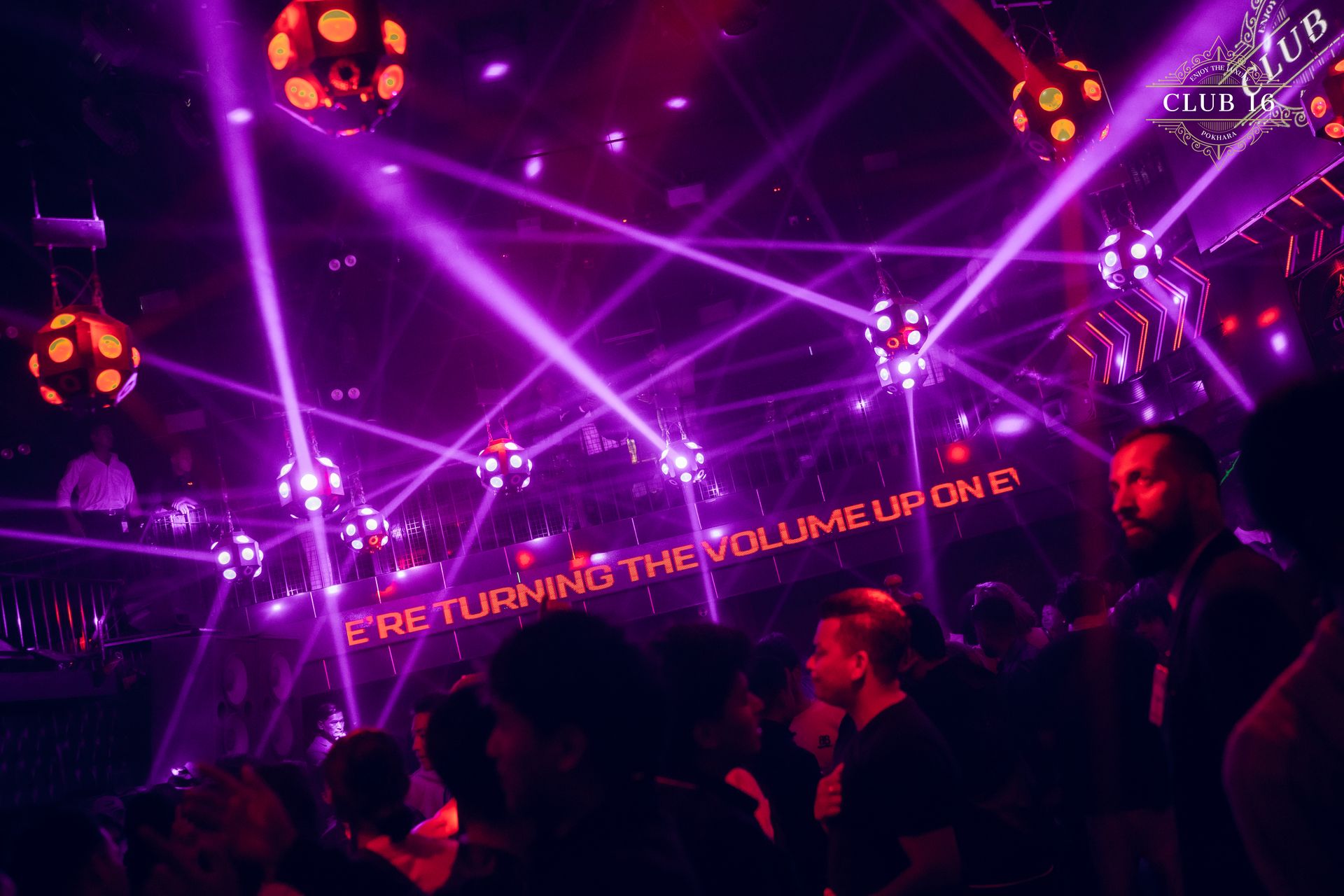
- 1–3 AM: Peak. The dance floor is packed, the lights are at full intensity, the sparklers and confetti cannons fire on the big tracks.
- 3–5 AM: Late energy. The committed crowd stays. The music gets bolder. The bar is friendlier. This is the magic window — most tourists have already left and the room feels like a private party.
- 5–6 AM: Wind-down. Momos appear. Friends linger. Pokhara's lake is just waking up.
If you arrive at midnight expecting Bangkok-pace, you'll think the country's asleep. Arrive at 12:30 AM understanding that you're early-mid in the actual rhythm, and you've cracked it. The full hour-by-hour playbook is in our first-timer's guide to Nepal nightclubs.
The Sound: What You'll Actually Hear
After dark in Nepal, the music is unexpectedly diverse. On any given Friday at Club 16 in Pokhara, you might hear a Bollywood hour at 11, a tech-house segment after midnight, a hip-hop block around 1, and a closing run of remixed Nepali folk anthems at 3 — all blended seamlessly by a single DJ. It's the kind of stylistic range that would be jarring elsewhere but somehow works here.
The country has also built a respectable DJ culture from scratch. The story of Nepal's growing DJ scene goes back further than most foreigners realise — local talents like Suraj KTM, Roxy June, Onderkoffer, and Kanxi have headlined the country's flagship nights for years. International touring acts increasingly include Pokhara on regional swings, and our exploration of Nepal's EDM clubs shows just how serious the scene has become.
Sound quality has also caught up. The flagship venues in Pokhara have invested in LW cinema-grade audio and proper club lighting. The result, when the room is full at 2 AM, is closer to a Berlin warehouse night than a backpacker bar — clean low end, room-shaking sub, controlled top end, no wash, no harshness. It surprises most first-time visitors.
The Drinks Culture
Nepali drinking culture after dark is generous but unpretentious. Local spirits — Khukri Rum, Royal Stag, Old Durbar — dominate the early hours. Cocktail bars get more elaborate as the night progresses, and Lakeside has quietly developed one of the most interesting mixology scenes in the region. Our round-up of Nepal's cocktail culture and the 20 best cocktail bars in Pokhara cover this in depth.
Hookah and shisha culture is also a defining feature of the Nepali after-dark experience. Lounges in both cities serve it openly, often as the centrepiece of a long social evening rather than an afterthought. If you've only experienced shisha as a quick novelty elsewhere, Nepal will surprise you.
What you won't find — and locals consider this a feature, not a bug — is the aggressive bottle-service culture that defines some Asian capitals. There's no velvet rope theatre, no minimum spend politics, no who-do-you-know hierarchy at the door. The biggest club in the country, Club 16, charges zero entry. The democratic feel is real.
Safety After Dark
This is where Nepal quietly outperforms its reputation. The country's nightlife is, by regional standards, remarkably safe — particularly Pokhara's Lakeside, where the layout is open, lit, and walkable from end to end. Most venues run their own pick-up and drop-off services. Group culture is the default. Solo female travellers consistently describe Nepali nightclubs as friendlier than what they're used to back home.
That said, common sense applies. Our guides to staying safe in Nepal's nightclubs and nightclub safety tips in Pokhara cover the small details — drink awareness, taxi negotiation, when to leave a venue, what to do if you lose your group. Worth reading once before your first night out.
The Lakeside Magic Hour
Anyone who has lived a real night out in Pokhara will tell you about the lakeside magic hour. Around 4:30–5:30 AM, the clubs start winding down, the streets empty, and a slow walk back to your hotel takes you along Phewa Lake. The Annapurnas catch the first wash of sunrise. The vendors are setting up. The temperature drops to that exact pre-dawn coolness. Most cultures don't have this — most cities don't allow this. In Pokhara, it's almost a ritual. The night doesn't end with you stumbling into a taxi. It ends with a quiet walk along still water under mountains that aren't yet awake.
This is the part of Nepal after dark you can't pre-book, can't photograph, and can't really explain to someone who hasn't been. It's also the part most regulars say they keep coming back for.
What the Locals Actually Do
Strip away the marketing and the local rhythm is simple. A typical weekend for a Pokhara native or a Kathmandu university student looks something like this:
- Dinner with friends at a familiar restaurant around 8.
- A drink or two at a casual bar from 10 to midnight — somewhere with seats and decent music, not the loudest room of the night.
- Move to the main event around midnight — usually Club 16 in Pokhara, or one of Thamel's flagship venues in the capital.
- Dance, smoke, drink, laugh, repeat until 4.
- Late-night momos. Always.
- Home by sunrise. Or breakfast first, depending on the company.
The recurring theme is that the night is unhurried. Locals don't try to maximise venues — they don't club-hop like backpackers in Bali. They settle in, commit to one room, and let the night build. Travellers who pick up this rhythm tend to have the best stories.
Where Club 16 Fits In
If you're trying to compress Nepal's after-dark scene into a single experience, Club 16 is the shortest answer. Free entry, open 9 PM to 6 AM every night, located on Street 16 in Pokhara's Lakeside. Cinema-grade LW sound, proper light show, full VIP lounge, hookah service, fire performers and saxophonists on big nights, free pick-up and drop-off across the city, and a crowd that mixes locals, trekkers, expats, and curious tourists into one of the most genuinely friendly dance floors in the region.
It's also the venue that quietly made the DJ Mag Top 100 Clubs list — a recognition the country had been waiting on for a long time. If you only have one night in Nepal and you want the real thing, you can stop reading travel guides and just walk through the door. The full Club 16 events calendar is online, and the team is reachable directly for table bookings, birthdays, or pick-up coordination.
Final Thoughts
Nepal after dark isn't loud about itself. It doesn't advertise the way Bangkok or Bali do. It doesn't have the global PR machine of Mumbai or Goa. But for the people who find their way into it — the trekkers who decide to stay an extra week, the locals who never left, the travelling DJs who keep coming back — it has a quiet conviction that you can't quite get anywhere else.
Come for the mountains. Stay for what happens after they go dark.
Ready to find out for yourself? See our upcoming events or book a table at Street 16, Lakeside, Pokhara. The night starts whenever you do.