When travellers map out Asia's great nightlife capitals, the usual roll call is reliable: Bangkok for the chaos, Bali for the beach clubs, Singapore for the polish, Tokyo for the all-nighters in Shibuya. Nepal almost never makes the list — and that, frankly, is the most exciting thing about it.
Because the truth is that Asia's nightlife map is being redrawn. The biggest cities are saturated. The biggest clubs charge cover prices that buy you a full night out somewhere else. And a new generation of travellers is hunting for nightlife that feels like discovery, not a guidebook checkbox. That's exactly where Nepal — and specifically Pokhara — is starting to win.
This is a confident claim, and we're going to back it up. Below is the honest case for why Nepal belongs alongside Bangkok, Bali, and Singapore on any serious shortlist of Asia's best nightlife destinations in 2026, and why Club 16 on Street 16, Lakeside, Pokhara is the venue that's making the strongest argument.
The State of Asian Nightlife in 2026
Let's start with the landscape. The current Asia top tier looks roughly like this:
- Bangkok — Ranked seventh in the world for nightlife. Royal City Avenue, Sukhumvit, Khao San. Massive variety, low prices, world-class DJ bookings at venues like Sing Sing Theater and Levels.
- Bali — Ranked thirteenth globally. Seminyak beach clubs (Potato Head, Ku De Ta), Canggu surf-house parties, Kuta backpacker bars. Defined by sunsets and sand under your feet.
- Singapore — Smaller scene but punching at the top end. Zouk at Clarke Quay regularly tops "best clubs in Asia" lists. Marina Bay rooftops. Premium prices, premium production.
- Tokyo & Seoul — Underground techno, all-night izakaya crawls, K-pop themed clubs.
- Ho Chi Minh City, Manila, Mumbai — Growing scenes, increasingly serious DJ bookings.
What unites the top of this list isn't just music or production — it's experience density. A great nightlife city packs world-class venues, late hours, accessible prices, and a crowd that actually wants to be there into the same square mile. By that test, Pokhara is more competitive than people realise.
Why Nepal Has Been Underrated
For years, Nepal's tourism story has been almost entirely about mountains. Trekkers fly in, head straight to Everest or Annapurna base camps, and fly out. The assumption that there isn't much to do at night has become self-fulfilling in some places — but it has never been true in Pokhara.
Pokhara is Nepal's tourism heart: lakeside cafés along Phewa Tal, paragliders falling out of the sky from Sarangkot, restaurants and bars stacked along a single walkable strip. Add a young domestic crowd from Kathmandu, a steady stream of international travellers between treks, and a thriving Indian tourist market, and you have exactly the demographic mix that builds great nightlife.
What was missing was a venue serious enough to anchor the scene. That's what changed.
The Club 16 Effect
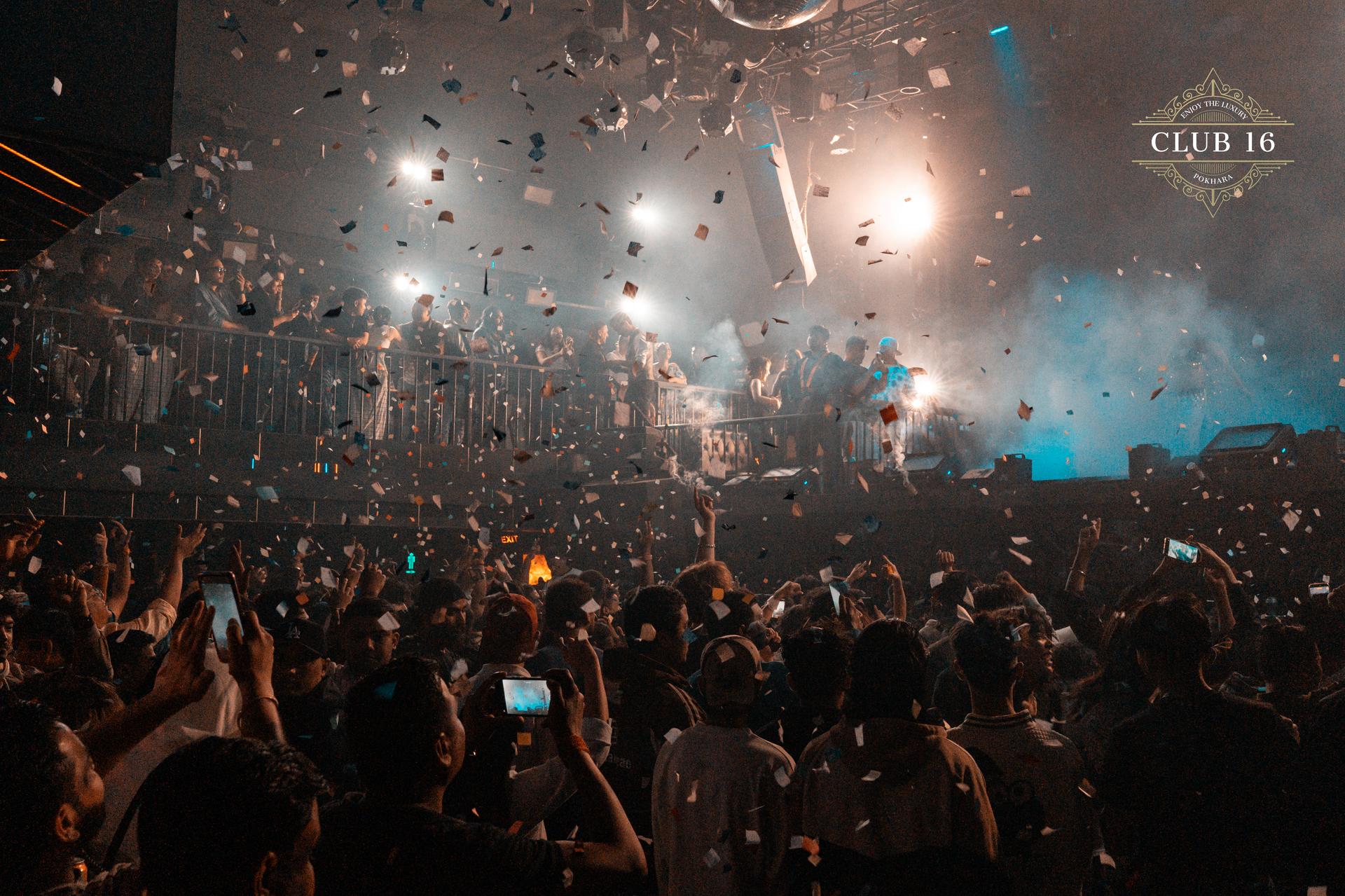
Club 16 sits on Street 16, Lakeside, Pokhara — two minutes from the lake, in the middle of the city's restaurant and bar strip. The fundamentals are simple, but they're built to international standards:
- LW cinema-grade sound system — not "pretty good for Nepal," genuinely on par with mid-tier clubs in Bangkok or Bali.
- Open 9 PM until 6 AM — a true late-night room, not a 1 AM curfew venue.
- Free entry — no cover, every night. In a region where Bangkok mega-clubs charge 800–1,500 baht and Singapore venues push past S$30, that alone changes the maths of a night out.
- Free pick-up and drop-off — anywhere in Pokhara. This is the single most underrated piece of hospitality in Asian nightlife and removes the safety question that haunts solo travellers and women in unfamiliar cities.
- VIP lounge, hookah, and a proper bar program — covering the upscale end without the upscale-only attitude.
- A working DJ academy — the Club 16 DJ Course is building the next generation of Nepali residents and guest performers.
That's a venue that would be respected anywhere on the Asian circuit. The fact that it's in Pokhara — surrounded by mountains, ten minutes from a lake, a fraction of the price of comparable rooms in Bangkok — is what makes it interesting.
How Pokhara Stacks Up Against Asia's Big Names
Let's do the comparison honestly.
Versus Bangkok
Bangkok wins on sheer scale. There is more nightlife per square kilometre in Sukhumvit than in the entirety of Pokhara, and that will not change. But the bottom 80% of Bangkok venues are noisy, transactional, and exhausting. The top 20% are excellent but expensive. Pokhara doesn't try to compete on volume — it competes on a single great room you can walk to from any lakeside hotel. For a focused, high-quality night out, Pokhara wins on signal-to-noise. We put that rivalry under the microscope in our full Nepal vs Thailand nightlife comparison.
Versus Bali
Bali's edge is the beach. There is no answer to a Potato Head sunset session anywhere in landlocked Nepal — and we wouldn't pretend otherwise. But Bali nightlife is concentrated in Seminyak and Canggu, and the actual late-night dance-floor scene is thinner than the Instagram feeds suggest. Pokhara's lakeside setting is its own kind of magic — paragliders by day, lakeside bars by night, mountain skyline always in view — and Club 16 is a true late-night club in a way most Bali venues are not.
Versus Singapore
Singapore is the premium tier — Zouk genuinely is one of Asia's best clubs and the Marina Bay rooftops are spectacular. But it is expensive in a way that limits a night to one or two stops. Pokhara delivers a night that, drink-for-drink, costs a quarter of what Singapore does, without sacrificing production quality. Different markets, different missions — and Pokhara's value proposition is far stronger for the traveller who wants to actually drink, dance, and stay until close.
For more on this specific comparison within Nepal itself, see our breakdown of Kathmandu vs Pokhara nightlife — Pokhara wins on density, accessibility, and atmosphere.
What Makes a Nightlife Destination Genuinely Great
Strip away the marketing language, and there are really five things that separate a great nightlife city from a forgettable one:
1. A venue worth flying for. Every top destination has one. Bangkok has Sing Sing. Bali has Potato Head. Singapore has Zouk. Nepal has Club 16. You don't go for the city — you go for the room. Then you discover the city around it.
2. A reasonable cost of a great night. Asia's best nightlife cities all share this. Pokhara's pricing — free entry, accessible drinks, no surprise cover — slots in alongside Bangkok and Bali and well below Singapore.
3. Late hours. A 1 AM close kills momentum. Club 16's 9 PM–6 AM window matches the best of Asia and outlasts plenty of supposedly "famous" venues.
4. Safety and ease. Free pick-up and drop-off in Pokhara is the kind of detail that gets word-of-mouth. Solo travellers and groups of women who've read our Pokhara nightlife safety tips know the difference between a city you can move around in and one you can't.
5. A scene with character. Nepal's nightlife isn't trying to be Bangkok or Bali. The mountain backdrop, the mixed local-and-international crowd, the post-trek euphoria in the room — it's a flavour you don't get anywhere else on the continent.
The Travellers Who've Already Figured This Out
There's a quiet shift happening in how people plan Asian trips. Backpackers who've done Thailand and Vietnam twice are looking for the next thing. Solo travellers want destinations where they can move at night without anxiety. Indian and Sri Lankan tourists — for whom Pokhara is a short, affordable hop — are arriving in record numbers and have made Club 16 a fixed point on their itinerary. Greek and European visitors flying in for the Himalayas are extending their stays specifically because the lakeside scene gives them a reason to.
If you're putting an Asia trip together for 2026 and your only nightlife stops are Bangkok and Bali, you're following a script written ten years ago. Adding three nights in Pokhara — with Club 16 anchoring the evenings — gives you a story no one else in your group will be telling.
How to Plan a Pokhara Nightlife Stop
Quick practical notes for anyone slotting Pokhara into a wider Asia itinerary:
- Best months: October to early December, and March to May. Avoid the monsoon (June–August) for outdoor lakeside experiences, though Club 16 runs year-round.
- How long: Two to four nights. Long enough to do the lake, a paragliding morning, a sunrise at Sarangkot, and two solid nights out.
- Where to stay: Anywhere in Lakeside. Club 16's free pick-up and drop-off means you don't need to choose accommodation based on proximity to the club.
- What to expect: A mixed crowd of locals, Indian visitors, and trekkers from twenty countries. Music spans EDM, Bollywood, hip-hop, and Nepali pop across the week — check the events page for upcoming nights.
- Dress: Stylish but not stiff. The vibe is closer to Bali smart-casual than Singapore black-tie. Our guide to dressing for a night out in Pokhara goes into more detail.
The Honest Final Word
We're not going to claim Nepal has overtaken Bangkok or that Pokhara is bigger than Bali. It hasn't, and it isn't. What we are saying is that the standard "best nightlife in Asia" conversation is overdue an update — and Nepal has earned a seat at the table.
The big cities will always have the biggest venues. But the best night of your Asia trip might not be in the city with the biggest scene. It might be in a room with cinema-grade sound, free entry, a lake outside, and the Himalayas an hour away. That room exists. It's been here for years. It's called Club 16, and it's why Nepal belongs on the map.
Planning to come see for yourself? Check our upcoming events, browse the gallery, or just walk in — Street 16, Lakeside, Pokhara. No cover, free pick-up, every night from 9 PM.