Five years ago, asking for a properly built negroni in most Nepali bars got you a confused look and a glass of warm Campari topped with sweet vermouth. Today, you can sit at a polished bar in Pokhara and watch a bartender stir, strain, and express orange oils with the same confidence you'd find in Singapore or Melbourne. The Nepal mixology scene has crossed a real threshold — and 2026 is the year the rest of the world starts to notice.
This is not a gentle evolution. It's a renaissance. New venues, returning diaspora bartenders, premium spirit imports, and a generation of guests who actually care about how their drink is made have collided to create something genuinely exciting. And right at the centre of that energy — yes, in Pokhara, not Kathmandu — sits Club 16, the venue that has spent the last two years turning craft cocktails from a novelty into a nightly expectation.
If you want to understand where Nepali nightlife is heading, you start with the glass in front of you.
Why Mixology Is Exploding in Nepal Right Now
A few forces are driving the boom, and they're all reinforcing each other.
First, tourism diversified. Trekkers and pilgrims still come, but so do urban travellers — couples on long weekends from Mumbai, digital nomads camping in Pokhara for two months, Greek and Italian honeymooners on bespoke itineraries. These guests have palates shaped by Soho, Tel Aviv, and Bandra. They notice when the ice is hand-cut and they definitely notice when it isn't.
Second, the diaspora came home with skills. Nepali bartenders who spent years working in Doha, Dubai, Hong Kong, and London started returning during and after the pandemic. They came back with technique, palate memory, and — crucially — networks of suppliers. The talent pipeline that used to flow only outward now flows both ways.
Third, import policy loosened just enough. Premium gins, mezcals, Japanese whiskies, and craft bitters that were impossible to find in Nepal three years ago now sit on real bar shelves. Not in every bar — but in the bars that matter.
Fourth, guests started asking for it. There's a new clientele — young Nepali professionals, returning students, Indian visitors crossing the border for the weekend — who'd rather sip one beautifully made drink than power through five anonymous ones. That demand changed the economics. Suddenly mixology pays.
If you're tracking the broader shift in Nepali drinking culture, our deep dive on Nepal cocktail culture maps the cultural side of this story in detail.
The Pokhara Cocktail Axis: How Lakeside Became Nepal's Mixology Capital
Most outsiders assume Kathmandu leads on nightlife — and on raw venue count, it does. But on craft? Pokhara has quietly overtaken the capital.
A few reasons:
- Lakeside is a single, walkable nightlife district. Bartenders move between venues, share techniques, borrow ice. That density creates a learning curve nobody in scattered Kathmandu enjoys.
- The clientele skews international. Trekkers fresh off the Annapurna circuit have time, money, and a willingness to try a NPR 800 cocktail. Kathmandu's nightlife is more transactional; Pokhara's is more curious.
- The lake forces a slower pace. A great cocktail is a contemplative thing. Pokhara, with the Annapurnas reflected in Phewa Lake, gives you the headspace to actually appreciate one.
We've broken this rivalry down before in our Kathmandu vs Pokhara nightlife comparison, but the cocktail gap has only widened since.
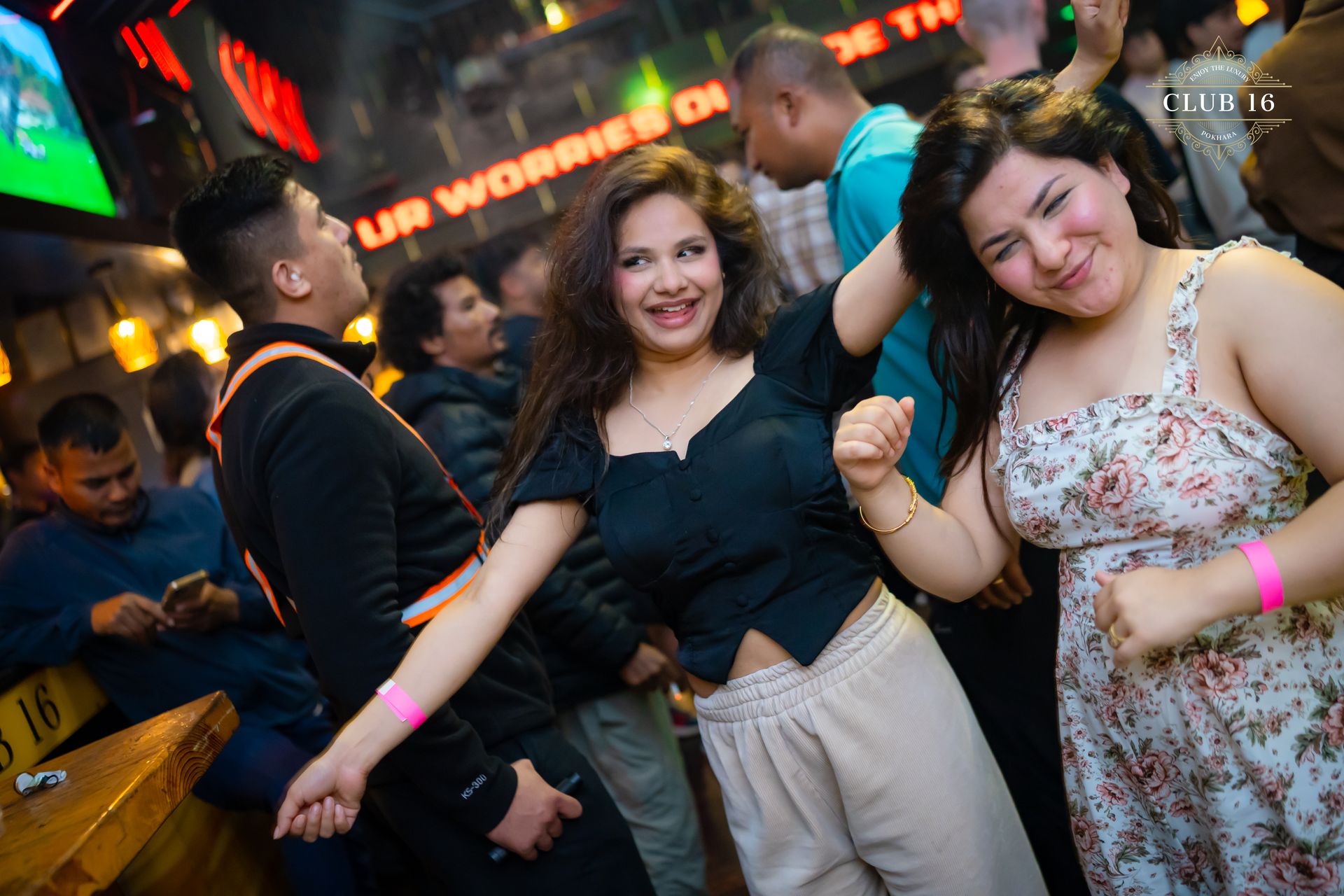
Within Lakeside, the cocktail axis runs from the rooftop bars near the northern end down to Club 16 on Street 16 — and Club 16 anchors the southern end of that axis. Walk in on any Friday after 10 PM and you'll see it: the bar is the busiest station in the room, and the people leaning on it aren't waiting for warm beer.
Inside Club 16: A Cocktail Program Built for the Long Run
Club 16 didn't set out to be a "cocktail bar." It's a nightclub first — Street 16, Lakeside, Pokhara, free entry, doors at 9 PM, lights down by 6 AM, full LW cinema-grade sound rig. But the team made an early call that changed everything: the bar wouldn't be an afterthought.
The result is a cocktail program with three layers.
The classics, properly built. Negroni, old fashioned, margarita, espresso martini, paloma — all on the menu, all built with the right spirit ratios and the right technique. No corner-cutting. If you order a daiquiri, it arrives in a chilled coupe with fresh-pressed lime, not bottled mix.
The signatures. A rotating list of house drinks built around what's actually growing in Nepal that month. Sea buckthorn collins in the cooler months. Timur-pepper margaritas year-round (the pepper is a lemony-floral cousin of Sichuan pepper, native to the Nepali hills). A Himalayan honey old fashioned that has, by now, converted more rum drinkers to whisky than any marketing campaign ever could.
The crowd-pleasers. Long drinks built for the dancefloor — strong enough to matter, refreshing enough to last the set. Our piece on the best nightclub drinks gets into why drink choice matters more than people think when you're planning to dance until 4 AM.
The other thing that separates a serious program from a casual one: garnish discipline. The bartenders at Club 16 treat garnishes as part of the recipe, not decoration. Expressed citrus oils, dehydrated wheels, micro-herbs — the small details that elevate a drink from "fine" to "memorable." If you want to nerd out on this, our guide to cocktail garnishes that actually elevate your drinks is required reading.
The Local Ingredients Reshaping Nepali Cocktails
What makes Nepal's mixology scene genuinely interesting — rather than just an imitation of Bangkok or Bombay — is the ingredient pantry that's slowly becoming standard behind Nepali bars.
Timur (Nepali pepper) brings citrus, floral, and a subtle numbing tingle. It works beautifully in tequila and mezcal drinks, where it amplifies brightness without competing with smoke.
Sea buckthorn grows in the high Himalayan valleys. Its berries are intensely tart, mineral, and orange-coloured — somewhere between passionfruit and gooseberry. As a syrup or shrub, it's a cocktail bartender's dream.
Chyang and tongba, traditional Nepali fermented millet drinks, are starting to appear as bases or modifiers in adventurous houses. The umami complexity is hard to find anywhere else in the world.
Himalayan honey, especially the wild varieties from cliff hives, has a smokiness that no commercial honey replicates. A teaspoon transforms an old fashioned.
Local citrus — Nepali limes, mandarins, and the smaller wild lemons of the hills — has acidity and aromatic profiles distinct from anything you'd find on a supermarket shelf.
The bars that lean into this pantry are building genuine identity. The ones that don't are just copying London menus into a Nepali room. Club 16 sits firmly in the first camp — and as the Nepal mixology scene matures, that distinction will only matter more.
The Talent Pipeline: Where Tomorrow's Bartenders Come From
A scene is only as strong as its next generation. Nepal historically lost its best hospitality talent to the Gulf and Southeast Asia. That's reversing — but slowly. The gap is being filled in three ways.
Returning diaspora. As mentioned, Nepali bartenders who built careers abroad are coming back to take head-bartender roles, train juniors, and open their own places.
In-house training. Serious venues are running their own academies. Club 16's parallel investment in talent is most visible in the DJ course — but the same philosophy applies behind the bar. Bartenders are coached on technique, palate, hospitality, and the business side. Nobody learns by accident.
Cross-pollination from food. Pokhara's restaurant scene has matured fast, and the cooks who spent five years in modern Kathmandu kitchens bring an ingredient-first sensibility into the bar. The line between chef and bartender is blurring everywhere — Nepal is no exception.
If you've ever wondered what it actually takes to do this work, our piece on how to become a mixologist walks through the path — and it's a path more young Nepalis are choosing every year.
What to Order on Your First Visit
If you're new to Club 16 — or new to Nepal's mixology scene generally — here's the order to actually understand the room.
Start with a Timur Margarita. It's the drink that announces what Nepali mixology can do. Bright, slightly numbing, deeply local.
Move to a Sea Buckthorn Collins. Refreshing, photogenic, and a clean palate reset before the night gets serious.
Finish with a Himalayan Honey Old Fashioned. Order it after midnight, when the dancefloor has thinned slightly and the lights are at their warmest. This is the drink you'll remember.
If you're with a group, order a signature house cocktail for everyone, then split into singles. The program is built to reward exploration. For a broader read on which drinks to actually order on a clubbing night in Nepal — and the smart way to pace them — our latest guide is a useful companion.
The Future: Where Nepal Mixology Goes From Here
A few predictions for the next 24 months.
Bottled cocktails and batch programs. Expect to see signature drinks pre-batched and bottled — both for dancefloor speed and for take-home retail. Several Pokhara venues are already experimenting.
A Nepal cocktail competition circuit. Singapore has its own. India has its own. Nepal's bartender community is dense enough now that a national competition is overdue, and 2026 is when it will likely materialise.
Cocktail-led travel itineraries. The same way wine country built tourism in California, Nepal's emerging cocktail axis will start anchoring trip itineraries. Pokhara nightlife — already a destination — will become a destination because of the bars, not just despite them.
Indigenous spirit production. Watch for craft Nepali gins distilled with Himalayan botanicals, and for serious investment in chyang and tongba as premium products rather than village drinks. The cultural value is enormous; the commercial value is finally catching up.
Come See It For Yourself
Reading about a cocktail scene only goes so far. The Nepal mixology renaissance is happening in real rooms with real bartenders, and the fastest way to understand it is to walk into one.
Club 16 sits on Street 16, Lakeside, Pokhara. Doors open at 9 PM, the music runs until 6 AM, entry is free, and a free pick-up and drop service runs throughout the evening so getting there isn't a logistics problem. The VIP lounge is bookable for groups, the hookah service runs all night, and the bar is staffed by people who genuinely care what's in your glass.
Check the events calendar for upcoming nights and DJ guests, browse the VIP and table options, and come find out why Pokhara — not Kathmandu — is where Nepal's cocktail renaissance is happening first.
The next round, as they say, is on the bar team.