Every city has a moment where it decides whether it is serious about nightlife.
In Pokhara that moment is around 1:15 AM. You are somewhere on Lakeside, the night is good, the group is finally warmed up — and then a bartender starts stacking chairs. The music drops a notch. Someone flips half the lights on. And you get the universal, apologetic, closing-time nod.
For a lot of visitors that is where the night ends, purely because nobody told them it did not have to.
Because Pokhara does have late venues. It has a room that runs until sunrise. It just is not evenly distributed across the strip, and the difference between knowing that and not knowing it is roughly four hours of your holiday.
This is the honest, unglamorous breakdown of how late Pokhara actually stays open.
The Short Answer
Pokhara's nightlife runs on three unofficial tiers, and almost every venue falls into one of them.
- The 11 PM tier — lake-view rooftops, restaurant bars, quieter Lakeside cafés. Beautiful at sunset, done by the time the night starts.
- The 1–2 AM tier — the large majority of Lakeside bars and live music venues. This is where most of the strip lives. Last call somewhere between 12:45 and 1:30, out the door by 2.
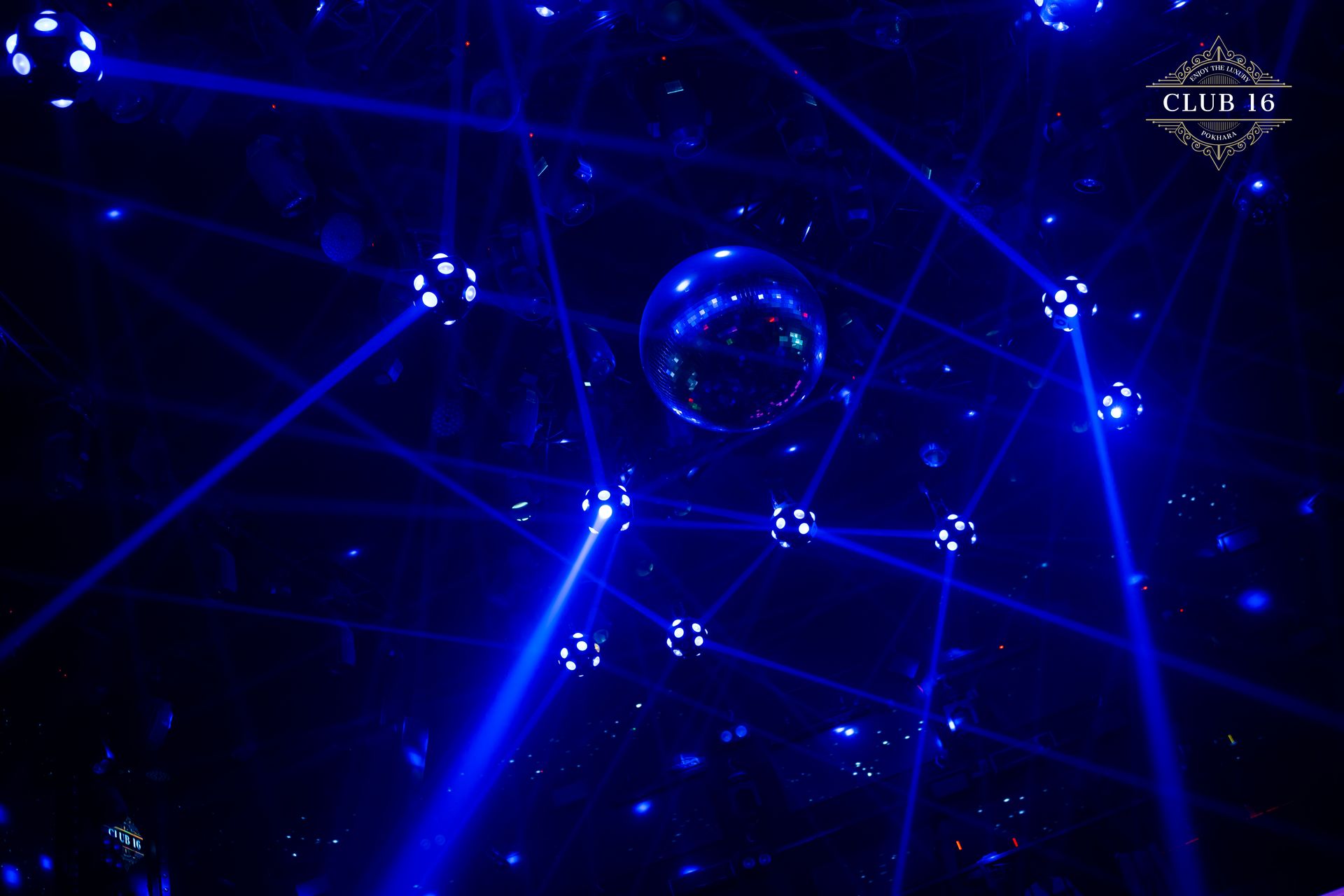
- The 6 AM tier — a very short list. Club 16 on Street 16 runs 9 PM to 6 AM, every night it is open.
Most guides stop at tier two, which is why so many people believe Pokhara "closes early." It does not. It just concentrates.
Why Most Venues Close at 1 AM (and Why It Is Not Laziness)
There is a real reason for the pattern, and it is worth understanding before you blame anyone.
Nepal's nightlife regulations have loosened significantly over the last few years, and Pokhara — as a designated tourism city — operates with more latitude than most of the country. But holding a licence to stay open is one thing; being built to stay open is another.
Running a room until 6 AM means a sound system that will not degrade over nine hours, a security team working genuine night shifts, a kitchen and bar stocked for a second wave that arrives at 2 AM, staff transport at dawn, and a physical space that can absorb the noise without the neighbours filing complaints. That is a structural commitment, not a decision made on a Friday afternoon.
Most Lakeside venues are restaurants with a bar attached, or bars with a small stage. Closing at 1 AM is not a failure — it is what they are for. The mistake is expecting the strip to behave like one continuous organism when it is really a warm-up sequence with a small number of real endpoints.
If you want the full picture of how the strip is laid out before you plan a night, our Pokhara nightlife guide for 2026 maps it out venue by venue.
What Actually Changes After Midnight
This is the part people who leave at 1 AM never find out about: the late crowd is a genuinely different crowd, and the room is a genuinely different room.
The tourists thin out and the city arrives. Before midnight, Lakeside skews heavily toward travellers on a schedule — people with a 5 AM Sarangkot sunrise or an early bus to Kathmandu. After 1 AM, that population is gone and the floor fills with Pokhara itself: locals, hospitality workers finishing their own shifts, university crowds, the people who actually live here.
The music stops apologising. Early sets are diplomatic. A DJ playing to a mixed dinner-and-drinks room at 10:30 is managing everybody at once. By 1:30 the room has self-selected, and the set gets braver — longer builds, harder drops, less crowd-pleasing, more actual mixing. If you only ever hear the early set, you have heard a nightclub doing customer service.
The energy stops being polite. There is a shift somewhere around 1 AM that regulars will recognise instantly. Nobody is checking a phone. Nobody is planning their exit. The floor stops being a place people visit and becomes a place people are.
It gets easier, not harder. Counterintuitively, the bar gets faster, the floor gets more space per person, and the staff have more time for you. Peak crush in Pokhara is 11:30 PM to 1 AM. After that it loosens.
Club 16: The 6 AM Room
Club 16 is on Street 16, just off Lakeside, and it is the venue the late half of this article is really about — because in practical terms it is the one that carries the night after the strip goes quiet.
The specifics that matter if you are planning to be out late:
Open 9 PM to 6 AM. Not "until late," not "until the crowd goes." A published nine-hour night. You can build a plan around it.
Free entry. No cover, no tiered door pricing, no couples-only rule. This matters more at 2 AM than at 10 PM — arriving late does not cost you anything, so a second-venue move is free.
LW cinema-grade sound. This is the technical reason a 6 AM room is even possible. A consumer rig pushed for nine straight hours starts to fatigue — the highs go harsh, the low end goes muddy, and your ears give up before the night does. A properly specified system sounds the same at 5 AM as it did at 10 PM, which is the entire difference between a long night and an endurance test.
Free pick-up and drop. The single most useful thing about a late venue is a solved exit. Club 16 runs complimentary pick-up from and drop-off to your hotel. At 5:30 AM in an unfamiliar city, this is not a perk — it is the reason the late night is actually available to you rather than theoretically available. For every other way to get home at dawn, read our Pokhara night transport guide.
VIP lounge and hookah. If your group is settling in for the long version of the night, there is table service and a hookah menu rather than nine hours of standing.
DJ courses. Worth knowing that the venue teaches as well as programmes — Club 16 runs proper DJ courses, which is a decent signal about how the music is treated.
Planning a Genuinely Late Night
If the goal is to still be dancing at 4 AM, the night has to be built for it. A few things that reliably work.
Eat properly at 8, not at 11. The single most common reason a group taps out at 1 AM is that they started drinking on a plate of chips. Eat a real meal on Lakeside early.
Do not start at 9. It sounds obvious and people still get it wrong. Arriving at a club at 9:15 means peaking at 11:30 and being finished at 1 — exactly when the night gets good. Start on the strip, move at midnight.
Pace the first two hours. Late nights are lost early. The 1 AM casualty rate in Pokhara is almost entirely decided between 9 and 11.
Sort the room the night before, not the night after. If you are out until 6 AM, you want a hotel you can walk into at dawn without a locked gate and a sleeping night guard. Ask about late entry when you check in — Lakeside hotels are used to the question.
Do not schedule a sunrise. Paragliding, Sarangkot, and an early Annapurna departure are all incompatible with a 6 AM exit. Pick one. Both is a myth.
Know where you are eating after. This is genuinely part of the night here, and Lakeside's late food scene runs well past 3 AM — momos, sekuwa, thukpa, fried rice. We wrote a full guide to eating after clubbing in Pokhara because a 4 AM plate of buff momos is not an afterthought, it is the closing ceremony.
Which Nights Actually Run Late
Not every night in Pokhara is a 6 AM night, and pretending otherwise would be dishonest.
Friday and Saturday are the reliable ones. Full programming, full room, full duration. Our weekend nightlife guide covers what to expect from each.
Sunday through Thursday varies with the season. In peak trekking months — October, November, March, April — midweek in Pokhara can run as hard as a weekend, because the town is full of people who just came off a mountain with nothing scheduled tomorrow. That crowd has a specific energy, and nightlife after trekking is its own experience.
Festival and event nights ignore the calendar entirely. Dashain, Tihar, Holi, New Year, and one-off DJ bookings will fill a Tuesday. The only sensible move is to check what is coming up rather than assume.
Monsoon months — June through August — are quieter across the whole strip. The room still runs, but the crowd is more local and more relaxed. Some people prefer it.
Staying Sensible at 4 AM
Late nights are not more dangerous in Pokhara — the Lakeside area is genuinely one of the calmer nightlife districts in South Asia — but late nights anywhere reward a bit of structure.
Keep the group together on the walk between venues. Keep your own drink in your hand. Use the club's own transport rather than negotiating with whoever is parked outside at dawn. Tell someone in your hotel roughly when you expect to be back. Carry photo ID; the drinking age is 18 and doors do check.
If you want the fuller version, Pokhara nightlife safety tips goes through it properly, and the club entry guide covers dress code and door expectations — which matter less late, but still matter.
The Point
Pokhara is not a city that closes early. It is a city where the late half is concentrated in fewer places than people expect, and where nobody hands you that information at check-in.
The lake at sunrise is genuinely one of the best things in Nepal. So is walking out of a room at 6 AM into that same light, still slightly deaf, with the whole of Lakeside empty in front of you and the Annapurnas going pink over the water.
You do not get the second one by accident. You get it by knowing where to be at 1:15 AM.
Free entry. 9 PM to 6 AM. Cinema-grade sound that holds up all nine hours. Free pick-up and drop back to your hotel whenever you decide you are done.
Have a look at what is on this month, check table and package options if you are bringing a group, or get in touch and we will sort it out before you arrive.
Street 16. We are open until the sun comes up.