There is one question that gets asked more than any other before a night out in Nepal, and it almost never gets a straight answer online: how much does it cost to get into a nightclub here?
Ask five people and you will get five numbers. Someone will swear they paid nothing. Someone else will tell you they handed over NPR 2,000 at the door and still had to buy drinks. A third person will mention something about "couple entry" and a fourth will describe a cover charge that came with a drink coupon that only worked on one specific beer.
They are all telling the truth. Nepal's nightclub entry pricing is genuinely inconsistent — it changes by city, by night, by whether you arrive as a group of guys or a couple, and by whether an out-of-town DJ happens to be on the decks. This guide breaks the whole thing down honestly, so you know exactly what to budget before you walk out the door.
The Short Answer: What You Should Expect to Pay
Across Nepal in 2026, nightclub entry generally falls into these bands:
- Free entry — a growing number of the country's better venues, including Club 16 in Pokhara, charge nothing at the door on regular nights. You pay for what you drink, nothing more.
- NPR 500–1,000 — the standard cover at mid-tier clubs in Kathmandu on a Friday or Saturday, sometimes redeemable against a drink.
- NPR 1,000–2,000 — typical for a bigger venue on a peak night, or when a guest DJ is headlining.
- NPR 2,500–5,000+ — reserved for New Year's Eve, Holi parties, Halloween and major touring acts. Often ticketed in advance rather than paid at the door.
- Table minimums (NPR 8,000–30,000) — not really an entry fee, but a spend commitment if you want a reserved table or VIP booth.
Those are the honest ranges. Anything outside them usually means either a very small local bar or a one-off international event.
Why the Numbers Vary So Much
1. Cover charge vs. minimum spend
These get confused constantly, and the difference matters to your wallet.
A cover charge is money you hand over to walk in. It is gone. A minimum spend means you commit to spending a certain amount inside — but that money comes back to you as drinks and food. A NPR 1,500 minimum spend is far better value than a NPR 1,000 cover, even though the bigger number looks scarier.
Always ask which one you are being quoted. Staff will tell you if you ask directly.
2. Stag, couple and ladies pricing
This is the single biggest variable in Nepal. Many venues price by group composition:
- Stag entry (a group of men, no women) attracts the highest cover — sometimes double.
- Couple entry is usually discounted or free.
- Ladies' nights frequently mean free entry and discounted drinks for women, most often on a Wednesday or Thursday.
If you are planning a night out as a group of guys, this is where your budget gets hit hardest. Knowing it in advance saves an awkward conversation at the door. Our ladies' night guide covers how the midweek pricing works in practice.
3. The night of the week
Sunday through Thursday, most Nepali clubs waive entry entirely — they want the room full. Friday and Saturday are when cover charges appear, because demand does the pricing for them.
4. Guest DJs and event nights
When a touring DJ is booked, the economics change. Someone has to pay the artist fee, and that usually means a ticketed door. This is fair — you are buying a show, not just a room. What is less fair is a venue charging headline prices for a resident DJ set, which does happen.
5. The city
Kathmandu's Thamel and Durbar Marg venues charge more often than clubs elsewhere, largely because rent and tourist volume support it. Pokhara has historically been more relaxed about entry pricing, which is one reason its scene grew so fast. If you want the full picture on how the two cities compare, we broke it down in our Kathmandu vs Pokhara nightlife comparison.
The Costs Nobody Puts on the Sign
Entry is only the first line of the bill. Here is what actually empties a wallet on a Nepali night out:
Drinks. The real expense. A beer runs NPR 400–700 at most clubs, cocktails NPR 600–1,200, and a bottle of spirits for a table starts around NPR 8,000. Budget your night around drinks, not the door.
Transport home. At 3 AM, ride-hailing surge pricing in Kathmandu or Pokhara can cost more than your entry did. This is the cost people forget every single time — and it is exactly why Club 16 runs free pick-up and drop-off for guests. Getting to the club and getting home safely should not be a line item.
Hookah. Usually NPR 800–1,500 per pot, shared across a group.
Coat check and lockers. Small, but they exist at some venues.
Late-night food. The momo run afterwards is basically mandatory. Our guide to late-night food after clubbing maps out where to go when the lights come up.
Add it up and a realistic mid-range night out in Nepal costs NPR 2,500–5,000 per person. The entry fee, if there is one, is rarely more than a fifth of that.
Is a Cover Charge Ever Worth It?
Sometimes, genuinely, yes.
A cover charge is worth paying when it filters the room. Venues that charge at the door often end up with a crowd that actively chose to be there — and that can mean better energy than a free venue that filled up with people wandering in from the street. A cover is also worth it when it is redeemable against drinks, or when it is buying you a genuine headline act with a proper production budget behind them.
A cover charge is not worth paying when the venue is half empty, when the sound system cannot justify it, or when the "guest DJ" turns out to be the same resident who plays every Friday. Trust your instincts. If you can hear the music from the street and it sounds thin, keep walking.
Entry price is only half the door question — our guide to nightclub age limits in Nepal covers how old you need to be and exactly which ID the door will accept.
How Club 16 Handles the Door
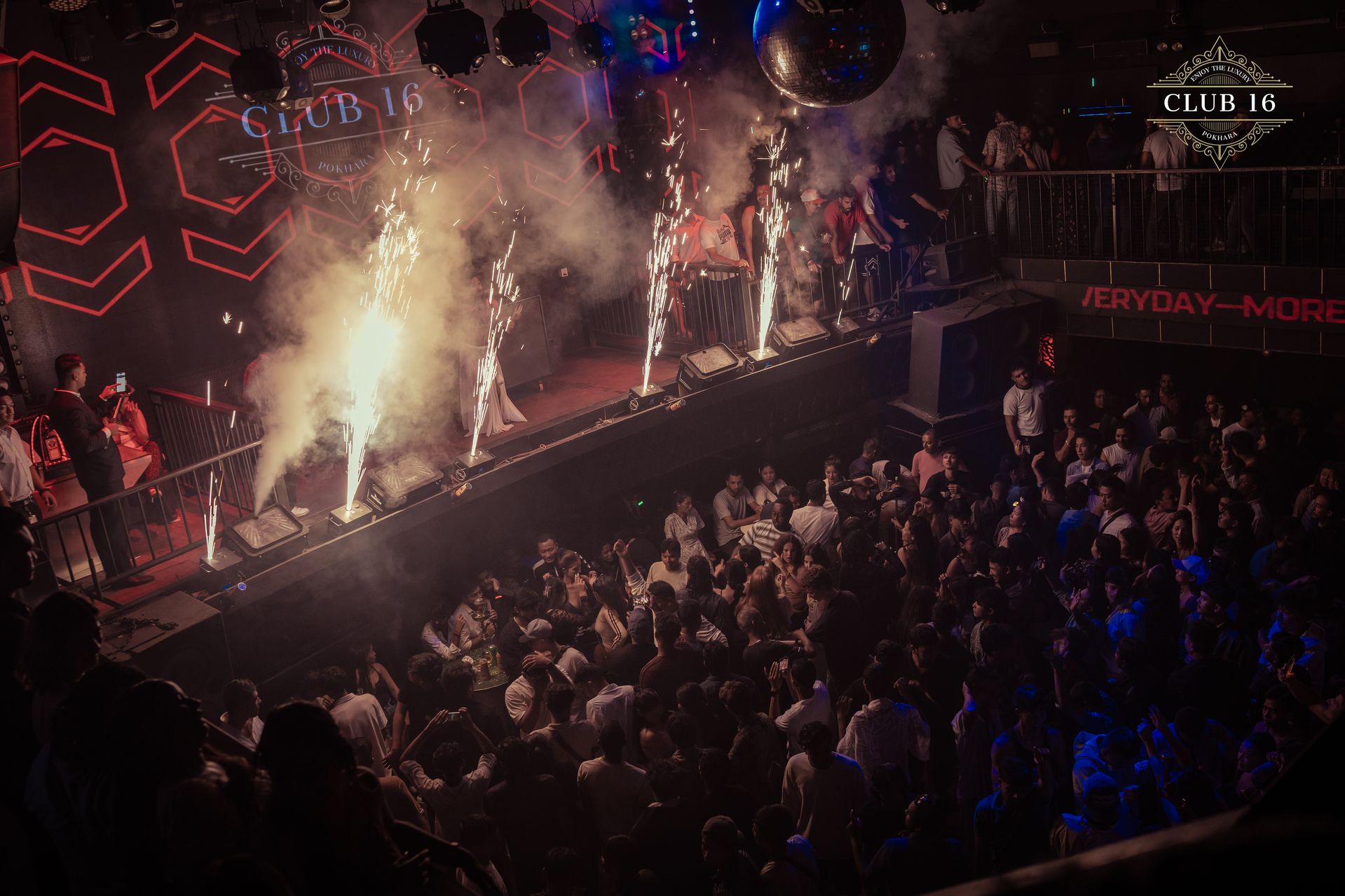
Here is our position, and we will be direct about it: Club 16 does not charge entry.
Not on Fridays. Not on Saturdays. Not for stag groups. The door on Street 16, Lakeside, Pokhara is free, and it stays free.
That is a deliberate decision, not a promotion. We would rather you spend your money on a drink you actually want than on a ticket to stand in a room. A club should earn its revenue by being somewhere worth staying for four hours, not by taxing you for the first thirty seconds.
What that money would have bought you, we put into the room instead:
- LW cinema-grade sound. The kind of system where you feel the low end in your chest rather than just hearing it. This is the single biggest reason people who have clubbed across Asia tell us Pokhara punched above its weight.
- Free pick-up and drop-off. No surge pricing at 4 AM. No arguments with a taxi driver. We bring you in and we get you home.
- 9 PM to 6 AM. Nine hours. Most venues in Nepal are winding down by 2. We are only halfway through.
- A VIP lounge and hookah service for when you want the night slower and closer.
- Resident DJs and a DJ course, because a club that trains its own talent does not need to import a headliner every weekend to justify a door charge.
If you are working out what a night here actually costs end to end, our Nepal nightlife budget guide has the full numbers, and the first-timer's guide to Nepali nightclubs covers everything else you might be wondering about before your first visit.
The reliable way to pay nothing at the door is to go midweek: our guide to student nights in Nepal covers which venues waive entry every week and what the rest of the night actually costs.
Practical Tips for Managing Entry Costs
Go early. Many venues that charge after 10 or 11 PM let you in free before that. Arriving at 9:30 also means you get the room while the sound is still clean and the bar is not four deep.
Go midweek. Sunday to Thursday is where the value is across the whole country.
Ask before you queue. "Is there a cover tonight, and is it redeemable?" is a completely normal question. Anyone who gets defensive about answering it has told you something useful.
Check the club's socials the same day. Event pricing in Nepal changes late and is announced on Instagram far more often than on any website. Club 16's events page lists what is coming up.
Book a table if there are five or more of you. Once you split a minimum spend across a group, a reserved table is often cheaper per head than buying drinks individually at the bar — and you get somewhere to sit.
Do not pay a stag premium without checking alternatives. If one venue wants NPR 2,000 from your group and another wants nothing, that is a NPR 2,000 head start on drinks.
What This Says About Nepal's Scene in 2026
The direction of travel is clear: the venues competing on experience are dropping their covers, and the venues competing on scarcity are raising them. Nepal's nightlife has matured enough that a club can no longer charge NPR 1,500 at the door and hand you a mediocre room. Guests have options now, they compare notes, and word travels fast in a country this size.
That is good for everyone. It means the door price is becoming an honest signal again — you pay when you are genuinely buying something extra, and you do not pay when you are not.
For a wider look at where the country's scene stands right now, our guide to the best nightclubs in Nepal covers the venues worth the trip.
The Bottom Line
Budget NPR 2,500–5,000 for a full night out in Nepal. Expect entry to be free on weeknights and at the better venues, NPR 500–2,000 at weekends elsewhere, and considerably more for genuine event nights. Always clarify whether you are being asked for a cover or a minimum spend. And remember that transport home is the cost that ambushes people, not the door.
Or skip the arithmetic entirely. Come to Street 16 in Lakeside, Pokhara. The entry is free, the pick-up is free, the sound is worth the flight, and the night runs until six in the morning.
Get in touch to arrange your pick-up or reserve a VIP table — and we will see you on the floor.