You have felt the difference even if you have never had the words for it.
There are clubs where the music is undeniably loud and you still find yourself checking your phone at half past midnight. And there are rooms where a track you have heard four hundred times suddenly reaches into your ribcage and decides on your behalf that you are not sitting down again until the lights come up.
Same song. Same DJ, sometimes. Completely different night.
The variable almost nobody talks about is the sound system — and more precisely, the marriage between the system and the room it lives in. In Nepal in 2026, this has quietly become the thing that separates the venues people travel for from the venues people tolerate because they happen to be nearby. So let us talk about it properly: what makes nightclub audio actually good, how to judge a room in your first thirty seconds inside it, and why the answer to "who has the best sound system in Nepal" is a question worth flying to Pokhara over.
Loud Is Not the Same as Good
This is the single biggest misunderstanding in clubbing, anywhere in the world.
Volume is easy. Any venue with a budget and a wall of speakers can produce something that hurts. What is hard — genuinely, expensively hard — is producing something that stays clean, detailed and physically exciting at high volume, for nine hours, with four hundred bodies in the room absorbing the top end.
A bad system announces itself in specific ways. The vocals turn to mush. The hi-hats hiss instead of ticking. The bass becomes one undifferentiated rumble rather than distinct notes you can follow. You start shouting to be heard by someone standing next to you, not because the music is too loud, but because it is occupying exactly the same frequency range as the human voice and winning.
A good system does the opposite. It gets louder without getting harsher. You can still talk to the person beside you at the bar. And the low end arrives as pressure on your chest rather than noise in your ears — which is the difference between hearing a drop and feeling one.
If you want a broader sense of where the country's venues currently stand, our guide to the best nightclubs in Nepal covers the rooms worth the journey.
The Four Things That Make a Nightclub System Sound Right
1. Headroom
Headroom is the gap between how loud a system is being asked to play and how loud it is capable of playing. A system running at ninety percent of its ceiling all night is a system that is straining, distorting and slowly cooking itself. A system running at forty percent has room to breathe — transients stay sharp, the kick keeps its punch, and nothing ever sounds like it is fighting you.
This is why serious venues over-specify. You do not buy the rig that just about covers the room. You buy the rig that covers it comfortably and then some.
2. Coverage
Coverage is whether the person by the toilets hears roughly what the person in front of the booth hears. In badly designed rooms there are dead zones where the music goes thin and hot spots where it becomes unbearable. People sort themselves into the good areas within twenty minutes and the rest of the floor stays weirdly empty all night.
Proper coverage means the whole floor is usable, which means the crowd spreads out, which means the room feels alive rather than clustered.
3. Room treatment
Here is the part almost every venue skips, because it is invisible and therefore feels optional. Concrete, glass and bare walls reflect sound. Those reflections arrive at your ears a few milliseconds after the direct sound and smear everything together. The result is a room that sounds "washy" no matter how good the speakers are.
Treatment — panels, diffusion, considered surfaces, even where the bar and booths sit — is what turns a large hard box into a listening space. You cannot see it working. You absolutely notice when it is absent.
4. Tuning
Every room has its own acoustic personality, and a system has to be tuned to it: measured, corrected, adjusted for a full house versus an empty one at 9 PM. A rig that has been properly tuned by someone who knows what they are doing will outperform a more expensive rig that was simply installed and switched on.
The best DJ in the country cannot rescue an untuned room. A well-tuned room, on the other hand, makes competent DJs sound excellent — which is part of why the players profiled in our look at the best DJs in Pokhara sound so much better in some venues than others.
How to Judge a Club's Sound in Thirty Seconds
You do not need a decibel meter or a trained ear. You need four quick checks, and you can run all of them before you have bought a drink.
Listen from the street. Before you walk in, pay attention to what escapes the door. If the only thing you can hear outside is a formless boomy thud, the system is bass-heavy and undisciplined. Good rooms leak surprisingly little, and what does leak sounds like music rather than a washing machine.
Try to talk at the bar. Stand at the bar, away from the stacks, and say something normal to a friend. In a well-designed room you will be heard at a raised conversational level. If you have to put your mouth against someone's ear at the bar, the mid-range is out of control.
Find the hi-hats. Pick any track and listen for the small metallic ticks on the off-beat. If they are crisp and separate, the top end is healthy. If they smear into a continuous hiss, the system is being pushed past what it can handle.
Feel where the bass lands. Walk onto the floor. Good low end is felt in the chest and the stomach — a physical push. Bad low end is felt as pressure in the ears and, an hour later, as a headache. Your body will tell you the truth faster than your ears will.
Run those four checks and you will know, before the second track finishes, whether you are staying.
Why Nepal's Sound Standard Has Jumped
Ten years ago, nightclub audio in Nepal was largely an afterthought. Venues bought whatever a supplier recommended, pointed it at the floor and hoped. The scene has changed dramatically since, for three reasons.
First, guests travel. Nepali clubbers and the tourists coming through Thamel and Lakeside have heard what a proper system sounds like in Bangkok, Dubai, Berlin and Goa. Once a crowd knows what good feels like, they stop accepting a wall of noise.
Second, the music changed. The genres carrying Nepal's floors right now — the sounds we mapped out in our breakdown of Nepal's club music trends for 2026 and across the country's growing electronic music scene — are built on sub-bass and fine detail. They simply do not translate on a system that cannot reproduce them. Play a modern afro-house record on a thin rig and you are playing a completely different, much worse song.
Third, competition. When one venue in a city invests seriously in audio, everyone standing on that dancefloor recalibrates their expectations permanently. That has been the story of Pokhara over the last few years, and it is why the city's scene grew faster than anyone predicted — a story we told in full in the Pokhara nightlife guide for 2026.
Inside Club 16's LW System
We will be direct about this, because it is the thing we are proudest of and the reason people get on a bus from Kathmandu on a Friday.
Club 16 on Street 16, Lakeside, Pokhara runs an LW cinema-grade sound system. Cinema-grade is not marketing language — it describes a class of system engineered for a specific job: delivering huge dynamic range with total clarity in a large enclosed space, with enough headroom that an explosion and a whisper are equally convincing. Take that engineering and point it at a dancefloor and the effect is uncanny.
What it means in practice, standing in the room:
- The low end is a physical event, not a noise. You feel the kick in your sternum. Bass notes are distinguishable from one another rather than merging into a single drone, so basslines actually groove instead of just rumbling.
- The vocals stay in front. Even at full tilt, a vocal hook sits clearly above the mix. This is the single hardest thing to achieve and the easiest to notice once you have.
- It does not get fatiguing. Because the system is nowhere near its ceiling, there is no distortion creeping in as the night gets bigger. This is why our floor is still full at 4 AM when other rooms have thinned out — your body has not been quietly worn down by nine hours of harshness.
- The whole floor works. Coverage was designed around the room, so there is no dead corner and no punishing hot spot in front of the stacks.
- It scales with the night. Levels are handled differently at 9 PM with fifty people in and at 1 AM with a packed house, because a full room absorbs sound very differently from an empty one.
A system like this changes what a DJ can attempt. Our residents can drop into a genuinely quiet passage and hold four hundred people in it, because the detail survives at low volume — and then bring it back with a low end that is felt rather than merely heard. That range is the entire craft, and most rooms in this country simply do not permit it. It is also what makes the live sets we cover in our guide to the best live music in Pokhara land the way they do.
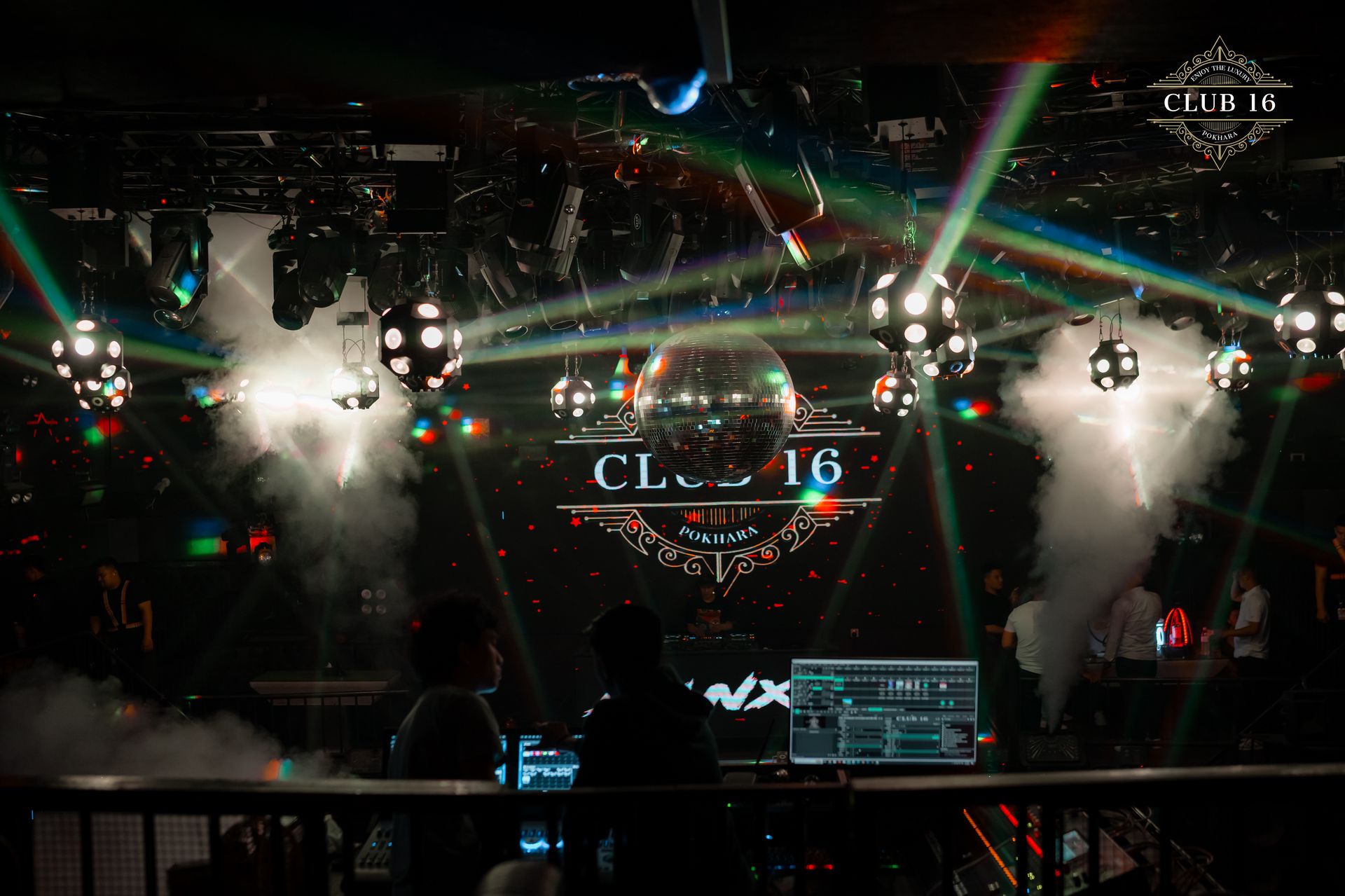
If you are curious what all of that looks like from the floor, the gallery is the closest thing to being in the room on a Saturday.
The Honest Caveats
Great audio does not guarantee a great night, and we are not going to pretend otherwise.
A perfect system in an empty room is still an empty room. Sound is a multiplier on atmosphere, not a substitute for it. You need the crowd, the lighting, the staff and the pacing of the night — a well-run venue understands that the system is one instrument in a much bigger arrangement.
There is also a point of diminishing returns. Beyond a certain standard, most guests genuinely cannot tell the difference, and a venue chasing specifications past that point is spending money on a spreadsheet rather than on your night. The useful question is never "whose rig is most expensive." It is "does this room make me want to stay until six."
And loudness is not virtue. A responsible venue keeps levels high enough to be thrilling and controlled enough that you can hear properly the next morning. If you leave a club with ringing ears every single time, that is not a great system — that is a poorly managed one.
Sound Is the Part of a Club You Cannot Fake
Lighting can be rented. Interiors can be redecorated in a fortnight. A guest DJ can be booked for one night and posted about for a week. Sound is the only part of a nightclub that cannot be borrowed, staged or photographed — it has to be built, tuned and maintained, and you find out the truth about it within thirty seconds of walking through the door.
That is exactly why we treat it as the foundation of everything else. It is the reason people who have clubbed across Asia walk into a room in Pokhara and stop mid-sentence. And it is why, when someone asks where the best sound system in Nepal is, we are entirely comfortable letting the room answer for us.
Come and run the four checks yourself. Listen from the street on Street 16. Try to hold a conversation at the bar. Find the hi-hats. Then walk to the middle of the floor and wait for the low end to arrive.
We are open 9 PM to 6 AM, entry is free, the pick-up and drop-off is on us, and there is a VIP lounge and hookah waiting if you want the night a little slower. See what is coming up on our events page, or get in touch to arrange your ride and reserve a table.
Bring good headphones-quality expectations. We will meet them.